
Snowy Owls and Lemmings-Prey Dynamics in the Arctic
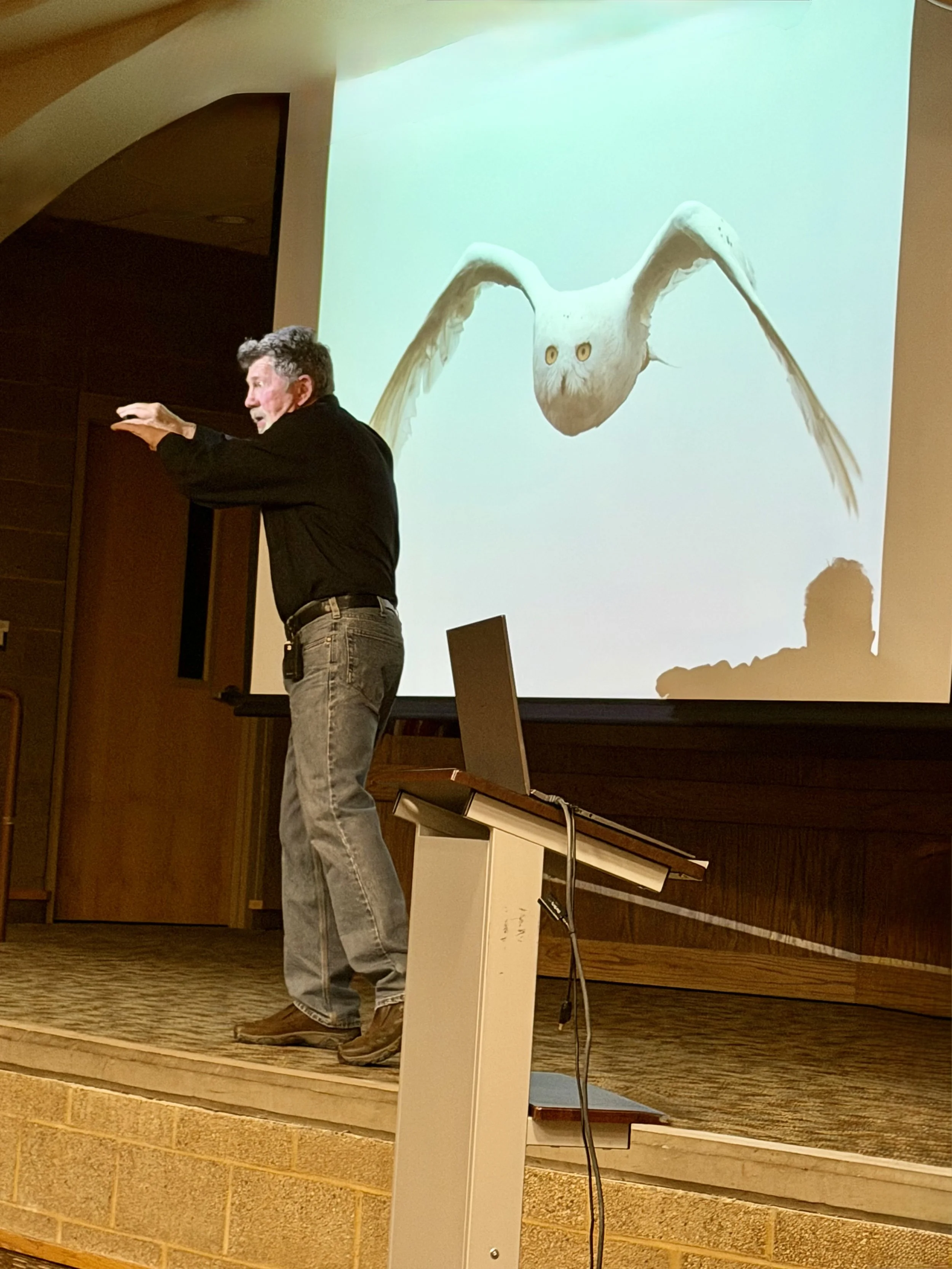
Denver Holt engages Coeur d’Alene community members as he presents at the Coeur d’Alene Library.
On May 13, 2026, Coeur d’Alene Audubon welcomed one of North America’s foremost owl researchers, Denver Holt, founder of the Owl Research Institute, for an unforgettable evening exploring one of the Arctic’s most iconic birds—the Snowy Owl.
The evening marked another important milestone for our chapter. It was our first public meeting held at the Coeur d’Alene Public Library, a wonderful new venue that welcomed approximately 130 attendees from throughout the Inland Northwest. Birders, photographers, conservationists, students, and nature enthusiasts gathered to hear firsthand from a scientist who has devoted more than three decades to understanding the Snowy Owl.
Denver’s presentation, Snowy Owls & Lemmings: 35 Years of Predator–Prey Dynamics in the Arctic, was both scientifically fascinating and remarkably accessible. Through stunning photographs, engaging stories from the Alaskan tundra, and decades of research, he revealed how the fate of one of the world’s most recognizable birds depends upon a tiny Arctic rodent weighing only a few ounces.
If you were unable to attend—or simply wish to experience the presentation again—you can watch the entire program here:
Presentation Recording:
https://drive.google.com/file/d/1NxJzlzEDYxsXMhFkieKC-BPFhTtNMRQc/view
A Lifetime in the Arctic
Denver Holt founded the Owl Research Institute in western Montana in 1988 and has become internationally recognized for his research on owls throughout North America and beyond. His work has been featured by National Geographic, documentaries, scientific journals, and conservation organizations worldwide.
Yet despite his impressive résumé, Denver’s presentation conveyed something more important than credentials: genuine curiosity.
Rather than presenting nature as something we have already figured out, he reminded us how many mysteries remain. Even after more than 35 years of studying Snowy Owls, many of their behaviors continue to surprise researchers.
That willingness to keep asking questions is what makes long-term science so valuable.
The Arctic’s Most Famous Owl
Few birds capture the imagination like the Snowy Owl.
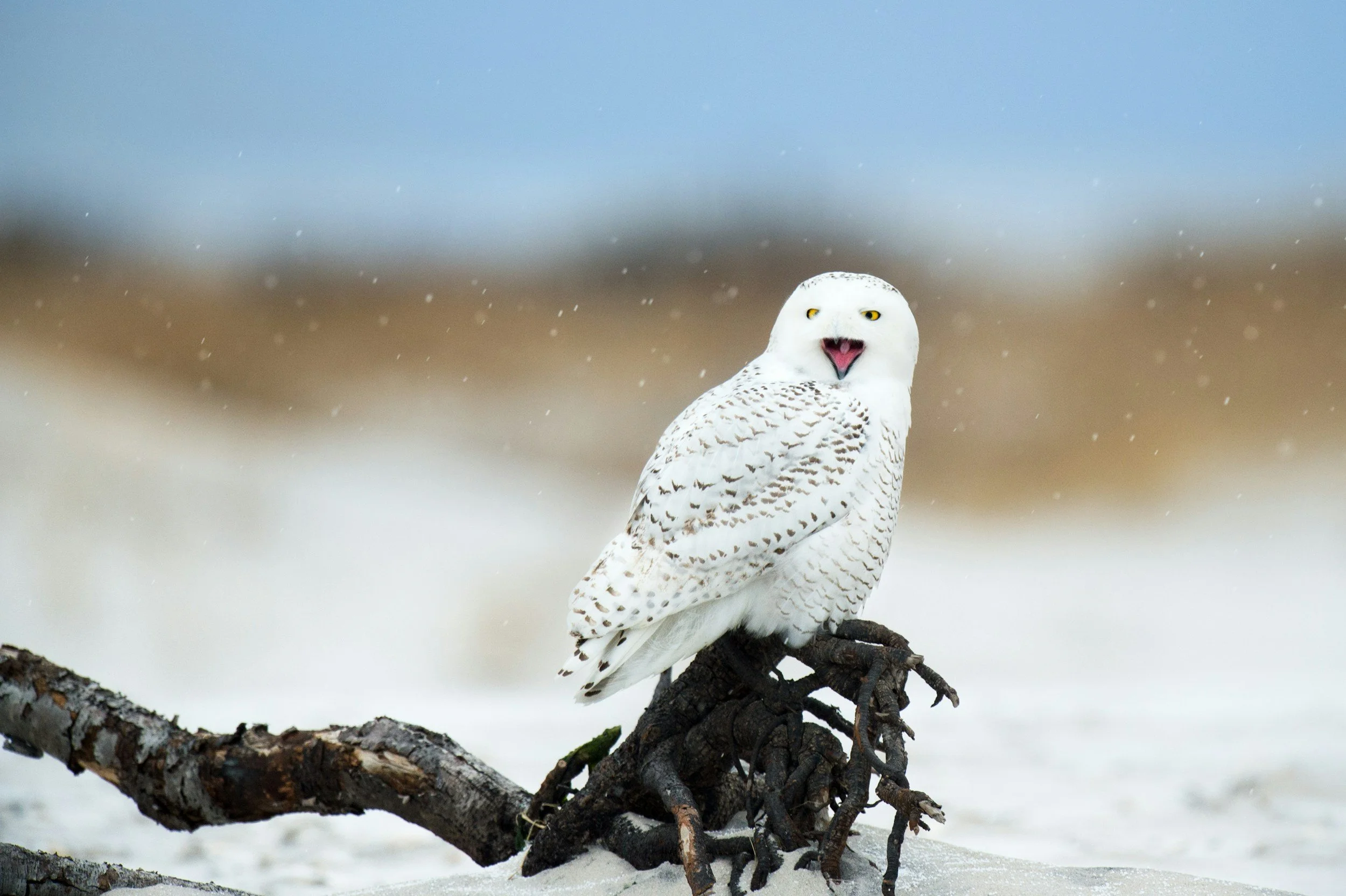
With its brilliant white plumage, piercing yellow eyes, and commanding presence, it has become an ambassador for the Arctic. Unlike many owls that hide within forests, Snowy Owls evolved on the open tundra where there are virtually no trees. They spend much of their time perched on slight rises, rocks, or even directly on the ground, scanning enormous landscapes for prey.
Although mature males may appear almost completely white, females and younger birds retain dark barring across their feathers throughout much of their lives. Those markings provide excellent camouflage against the varied textures of snow, tundra vegetation, and exposed earth.
Snowy Owls are powerful hunters capable of capturing birds, waterfowl, fish, rabbits, and other mammals. But during the breeding season, one prey species dominates nearly everything else.
The humble brown lemming.
The Little Mammal That Drives Everything
One of the evening’s most fascinating lessons was how completely Snowy Owl reproduction depends upon the abundance of lemmings.
In productive years, brown lemmings can comprise approximately 95 percent of the breeding season diet of Snowy Owls. When lemming populations are abundant, owls establish territories, lay eggs, and successfully raise large broods of chicks.
When the lemming population is low, the owls often simply do not breed.
That fact surprises many people.
Researchers have documented years with dozens of nests across their Alaska study area—and other years with very few. The difference is largely explained by the abundance of lemmings.
Thirty-Five Years of Questions
One of the greatest strengths of Denver Holt’s work is its remarkable duration.
Many wildlife studies last only a few years because funding ends or researchers move on.
The Snowy Owl project has continued for more than three decades.
That consistency allows researchers to see patterns that would otherwise remain invisible.
During that time, Denver and his colleagues have documented nesting success, chick development, plumage changes, diet, migration, satellite movements, behavior, and predator-prey relationships. They were also among the first researchers to track Snowy Owls using satellite transmitters, opening entirely new windows into the birds’ movements across the Arctic and beyond.
Long-term data also reveal something more sobering.
Although Snowy Owl populations naturally fluctuate from year to year, the overall trend in the institute’s Alaska study area has been downward, paralleling declines in lemming abundance. Researchers continue investigating whether changing Arctic conditions—including climate-related changes affecting vegetation, snow conditions, and prey populations—may be contributing to these declines.
Life on the Tundra
Denver’s stories illustrated that Arctic fieldwork is far from glamorous.
Researchers spend weeks living in remote environments where weather changes quickly, insects can be relentless, and travel across vast landscapes demands patience and resilience.
Yet those hardships are rewarded with remarkable discoveries.
Researchers monitor nests, carefully band chicks, measure growth, document prey brought to nests, and record countless behavioral observations.
Some nests become surrounded by cached lemmings—food stored by adult owls to feed growing chicks. During especially productive years, researchers have documented astonishing numbers of prey items accumulated around nests, a vivid reminder of just how abundant food can become when conditions align.
More Than Predator and Prey
One of the most important messages of the evening was that ecology is about relationships.
Snowy Owls cannot be understood without understanding lemmings.
Lemmings cannot be understood without understanding Arctic vegetation.
Vegetation depends upon snow cover, soil conditions, seasonal temperatures, and precipitation.
Every part of the Arctic ecosystem is connected.
Changes affecting one species ripple outward through countless others.
Denver’s work reminds us that conservation is rarely about protecting a single charismatic animal. Instead, it requires preserving entire ecosystems and understanding how those ecosystems function over decades.
Why Long-Term Research Matters
In an age when quick answers are often expected, Denver Holt’s career demonstrates the value of patience.
Thirty-five years of consistent observation have produced insights that simply could not have been gathered in a three-year grant cycle.
Long-term research reveals trends.
It distinguishes unusual years from meaningful patterns.
It allows scientists to recognize emerging conservation concerns before they become crises.
An Evening That Inspired
For everyone in attendance, Denver’s presentation was more than a lecture.
It was a reminder that scientific discovery begins with careful observation.
It begins with asking questions.
It begins with returning to the same place year after year because every season adds another piece to the puzzle.
Many audience members commented afterward on the beauty of the photography, the fascinating stories from Alaska, and the surprising complexity hidden within what first appears to be a simple predator-prey relationship.
Those are the presentations that stay with us long after the lights come up.
Thank You
Coeur d’Alene Audubon extends our sincere gratitude to Denver Holt and everyone at the Owl Research Institute for sharing decades of knowledge, research, and unforgettable stories from the Arctic.
We are equally grateful to everyone who joined us for this inaugural program at the Coeur d’Alene Public Library. Seeing approximately 130 community members gather to celebrate science, conservation, and birds was an inspiring beginning to this new chapter in our meeting history.
Programs like these remind us why Audubon exists—not simply to identify birds, but to better understand the natural world and to inspire stewardship through education.
If you missed this remarkable evening, we encourage you to watch the recording and experience one of North America’s leading owl researchers as he shares the extraordinary story of Snowy Owls, lemmings, and one of Earth’s most remarkable ecosystems.
We hope you’ll join us for future Coeur d’Alene Audubon programs as we continue bringing outstanding speakers and conservation stories to our community.
#SnowyOwl #DenverHolt #OwlResearchInstitute #CoeurdAleneAudubon #Audubon #CdALibrary #BirdConservation #OwlsOfNorthAmerica #ArcticWildlife #ArcticEcology #Lemmings #CitizenScience #EnvironmentalStewardship #NorthIdaho #InlandNorthwest #IdahoBirding #LoveBirds #ProtectBirds